
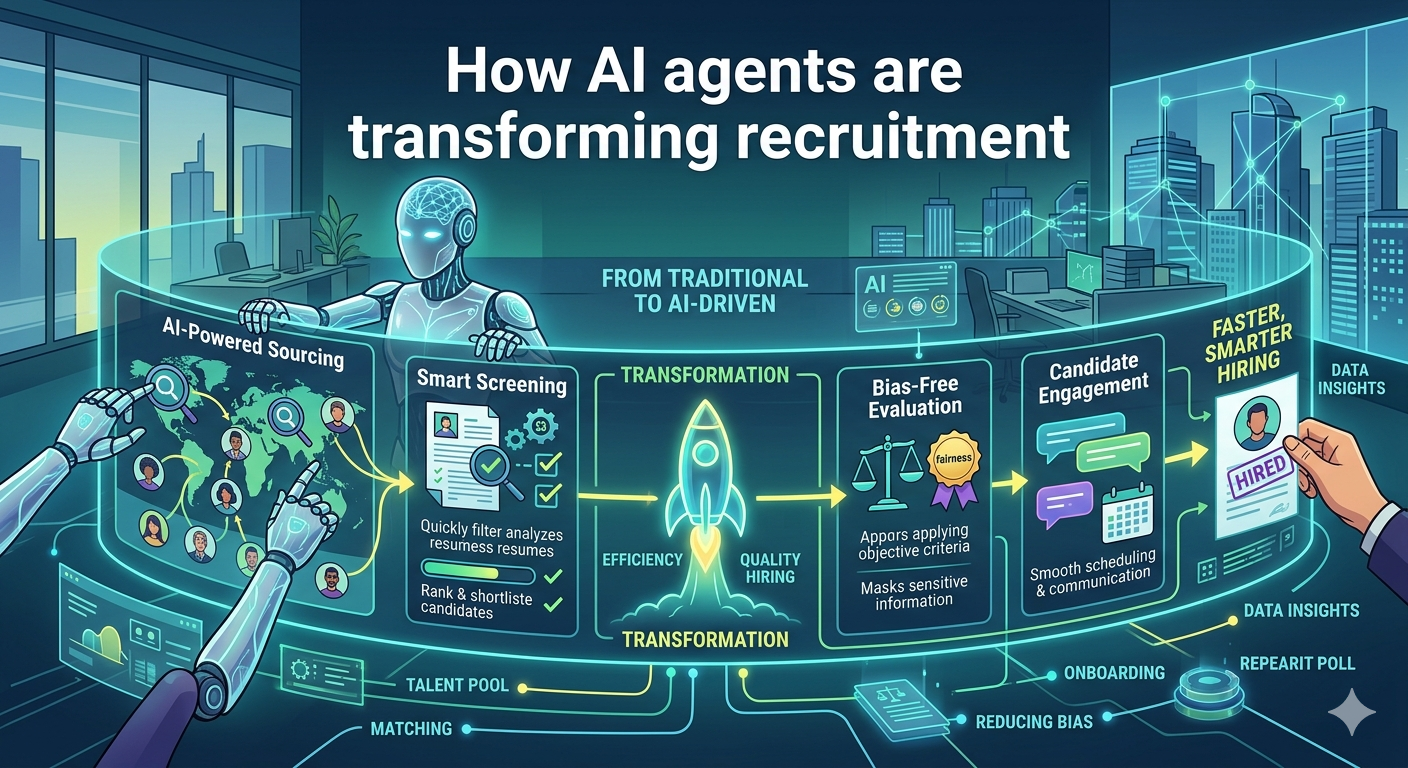
The hiring landscape is changing fast. Across industries, HR teams are discovering that AI agents can take on many of the repetitive, time-consuming tasks that once slowed down their recruiting pipelines. What was once a slow, manual process is now becoming an intelligent, automated workflow — and the organizations that adapt earliest are already pulling ahead.
Traditional recruitment involves hours of manual work: reading hundreds of résumés, comparing candidates, coordinating interview slots, and sending follow-up emails. AI agents now handle all of this autonomously. They can screen applicants based on job requirements, rank candidates by fit, and schedule interviews — all in minutes.
What used to take a recruiter an entire week can now be completed before lunch. The agent reads every application with the same level of attention, scores each candidate against the job requirements, and produces a ranked shortlist ready for human review. Calendar coordination happens automatically, removing one of the most frustrating back-and-forths in the hiring process.
What sets modern AI recruiting agents apart from basic automation tools is their ability to reason and adapt. A well-designed AI agent understands context. It can identify transferable skills, flag potential red flags, and even surface passive candidates from LinkedIn who weren't actively applying. These agents don't just follow rules — they learn from patterns and improve over time.
This distinction matters. Rule-based systems break the moment a candidate's background doesn't fit a predefined template. AI agents, by contrast, can evaluate a software engineer's open-source contributions as evidence of technical skill, or recognize that a candidate from a different industry brings exactly the cross-functional experience a growing team needs.
AI agents also improve the candidate experience. Faster response times, clearer communication, and more relevant job matches mean applicants feel respected and heard — even at scale. For HR teams, the result is more bandwidth to focus on relationship building and strategic decisions.
Candidates today expect a fast, transparent process. An AI agent can acknowledge applications instantly, provide status updates throughout the hiring process, and answer common questions about the role or company — all without adding to the recruiter's workload. This responsiveness builds trust and strengthens the employer brand.
One of the most impactful — and often underappreciated — benefits of AI recruiting agents is their ability to reduce unconscious bias. Human screeners, even well-intentioned ones, can be influenced by factors unrelated to job performance: the name on a résumé, the university attended, or the order in which applications are reviewed.
AI agents evaluate every candidate against the same criteria, consistently, without fatigue. When properly configured, they focus exclusively on skills, experience, and demonstrated results. This leads to more diverse shortlists and fairer outcomes for candidates from underrepresented backgrounds.
Companies using AI recruiting agents report significant reductions in time-to-hire and cost-per-hire. More importantly, they see improvements in quality-of-hire — because AI removes unconscious bias from the early screening stages and evaluates candidates more consistently.
The teams seeing the greatest gains aren't those who replaced their recruiters with AI — they're the ones who empowered their recruiters with AI. The agent handles the volume; the human handles the judgment. Together, they build hiring pipelines that are faster, fairer, and more effective than either could manage alone.
The shift to AI-assisted recruitment isn't a distant future. It's already here — and the teams embracing it are gaining a real competitive edge in the war for talent.
Ready to see what an AI Agent applicant tracking system looks like in action? Sherpa combines ATS, CRM, sourcing, and analytics in one platform, with AI built into every workflow. Request a demo.

Stop managing your ATS.
Let Sherpa run it for you.